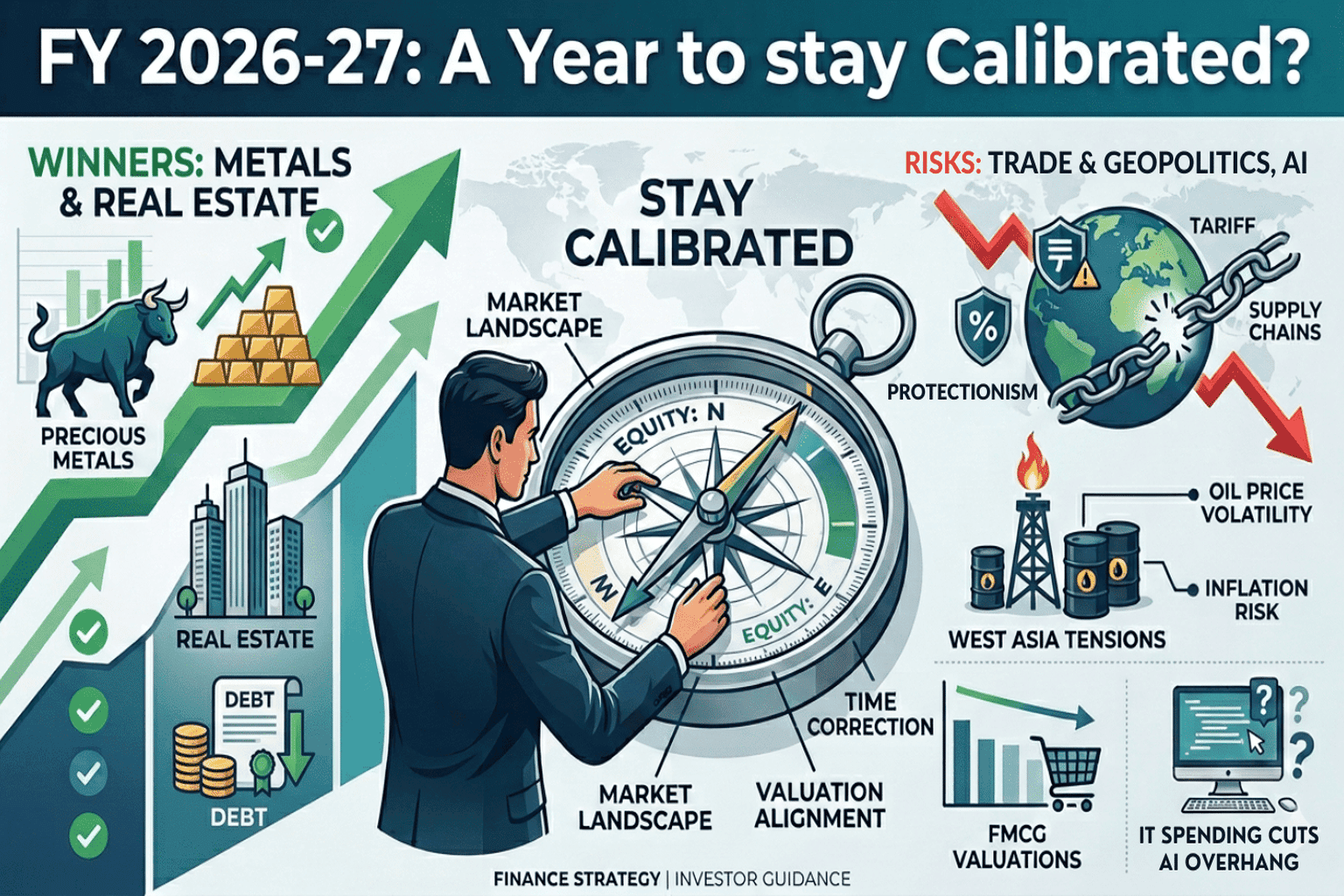
As FY 2025–26 draws to a close, the return landscape has narrowed considerably. Real estate and metals have outperformed. Debt instruments have also delivered good returns, thanks to the falling interest rates. However, equities have delivered muted or near-zero returns. That, by itself, is not unusual as markets often move in cycles, and not every year is a bumper year for every asset class. What deserves closer attention, however, is the earnings and valuation context as we step into FY 2026–27.
Let us look at the ground reality of a few sectors and what they are telling us.
FMCG has corrected reasonably from its peak, but even after that pullback, valuations continue to sit above long-term comfort zones, and the margin of safety is not still favourable for investors. The probability of outsized returns from current levels appears measured rather than compelling.
IT went through an aggressive valuation re-rating over the last few years, moving well above its historical P/E averages. We are now seeing a normalization towards historical averages. Adding to this is the structural overhang around AI and global tech spending cuts which is keeping the sentiments divided. When ten analysts give ten different views on the same sector, that clearly signals a subdued conviction.
Pharma, particularly export-oriented generics, continues to navigate a tough terrain of regulatory pressures, pricing headwinds, and geopolitical undercurrents that affect global supply chains. The sector remains selective rather than a broad-based opportunity.
The capital market, by design, discounts future earnings often 12 to 24 months in advance. When multiple data points simultaneously question the pace of earnings growth, markets typically respond with time corrections – long phases where returns stagnate while valuations quietly align with fundamentals. Indian markets have been experiencing time correction over last year or more and the same seems continue ahead too.
The Global Backdrop — Uncertain, But Not Uncharted
Globally, the macro picture is layered with complexity. The ongoing shift from globalization toward protectionism, unsettled trade equations, evolving supply chains, and currency volatility are all adding noise to an already cautious market environment.
And then there is the West Asia situation which, as of now, continues to escalate. The risk of disruption to oil supply from this region is not something the markets can ignore lightly. A substantial shock to oil supply can transmit quickly into energy prices, inflation, and consequently, central bank policy globally. India, as a net oil importer, remains particularly sensitive to this. Several Indian companies also have business exposure to the Middle East across sectors and any prolonged instability in the region could temporarily impact their order flows, trade volumes, or profitability for such businesses.
That said, this is not a new story for the world. We have seen West Asia tensions disrupt markets before too. The Gulf War in 1990, the Iraq invasion in 2003, the Strait of Hormuz tensions in 2019 – each time, there was fear, oil spiked, markets wobbled, and over time, they found their footing. History tells us that geopolitical events create volatility, but they rarely permanently alter the trajectory of well-structured, fundamentals-driven portfolios. Markets typically correct sharply only when confronted with events they have not anticipated and this one was squarely on everyone’s radar.
What About Other Asset Classes?
Precious Metals: Gold and silver have already seen significant rallies. The geopolitical stress in West Asia, combined with global macroeconomic uncertainty, may keep prices elevated for a while longer. But do not mistake this as an invitation to chase.
Precious metals at elevated levels carry asymmetrical risk in short-term. The right way to think about gold in your portfolio is as a hedge – a cushion against black swan events, currency depreciation, and geopolitical shocks. It is not a momentum trade. If you do not already hold gold as a strategic 10–15% allocation in your overall portfolio, a measured, staggered entry makes sense, purely from a portfolio construction standpoint. Pouncing on it for short-term gains at these levels is a different game altogether, and one that history rarely rewards.
Fixed Income offers limited comfort with interest rates near cyclical lows. Bond funds can face mark-to-market pressure if inflation surprises on the upside, which is a genuine risk given the oil price trajectory.
Hybrid (Dynamic Asset Allocation) and Multi-Asset strategies appear structurally more balanced for this environment. They allow dynamic repositioning across asset classes without requiring the investor to make those calls themselves. Tax implications and suitability vary by investor profile, so a detailed consultation with your advisor is important before taking the plunge.
So Where Does This Leave You as an Investor?
This is where I want to speak plainly, because this is what matters most.
If your investment horizon is 8–10 years or even 5–6 years: You need to be mentally prepared to see your portfolio value under pressure in the near term. There will be months, possibly quarters, where your portfolio statement does not look exciting. That is not a problem, that is the nature of equity investing. The investors who build real wealth are not the ones who exit when markets corrected; they are the ones who used that correction to add more money systematically. Volatility is not your enemy. It is actually your ally, if you stay disciplined. Use SIPs, use lumpsum top-ups during dips or Systematic Transfer Plans (STP), and let time do its work. Honestly, this is the only way for long-term wealth creation in equity.
If you need the money in the next 2–3 years: Equity is simply not the right instrument for a shorter time horizon. This does not mean you exit everything in panic. It means you systematically review how much of your portfolio is in equity, and whether that exposure is appropriate given your actual timeline. If a significant portion of your intended near-term requirement is sitting in equity, consider a phased move toward debt or liquid instruments. Protecting capital matters far more than chasing return when your time window is short.
Existing long-term investors may focus on prudent, disciplined allocation. Avoid drastic exits, avoid overreacting to headlines, and stay aligned with your original financial plan.
Investors approaching retirement need a granular portfolio review with sharper focus on downside protection, cash-flow adequacy, and reducing concentration risk.
One Line to Remember
Markets rarely reward extreme positioning – neither blind aggression nor paralysed caution. In phases like this, calibration matters more than conviction.
The views shared above are personal views of the writer. They are purely for educational and informational purposes. Investment decisions must be made after a detailed personal consultation with your Mutual Fund Distributor or Financial Advisor, keeping in mind your specific financial goals, risk appetite, and investment horizon.

Shreedhara is the Founder & Director of Ara Financial Services Pvt. Ltd. He has an experience of over 2 decades in Financial Service Industry with majority of it in guiding individuals and institutions on their investments requirements.