
I want to tell you the story of a customer. Let’s call her Shilpa.
In 2021, Shilpa had invested in equity mutual funds for the first time. Within months, her portfolio was up significantly. Markets were doing well; she felt investing is simple and even predictable.
Then came 2022.
Markets corrected. Her portfolio value dipped. And in our next conversation, her tone had completely changed. Shilpa asked me, “Is equity really reliable? Should I reduce my exposure?”
What struck me was how quickly her belief in equity had changed.
A story of Nifty 50
Let’s look at the journey of the Nifty 50 over the past few years:
- Jan 2020: ~12,000
- Mar 2020: ~7,500 (sharp pandemic-driven fall)
- Oct 2021: ~18,500 (strong recovery and rally)
- Early 2022: ~16,000 (correction phase)
- 2024–26: hovering around ~21,000 to 24000 levels
Now, here’s what my customers felt at these points:
- 2020: “Markets are risky.”
- 2021: “Markets are easy money.”
- 2022: “Markets are unpredictable.”
Do you see the contrast?
The market was the same. The opinions changed at different times.
What Drives These Changing Beliefs?
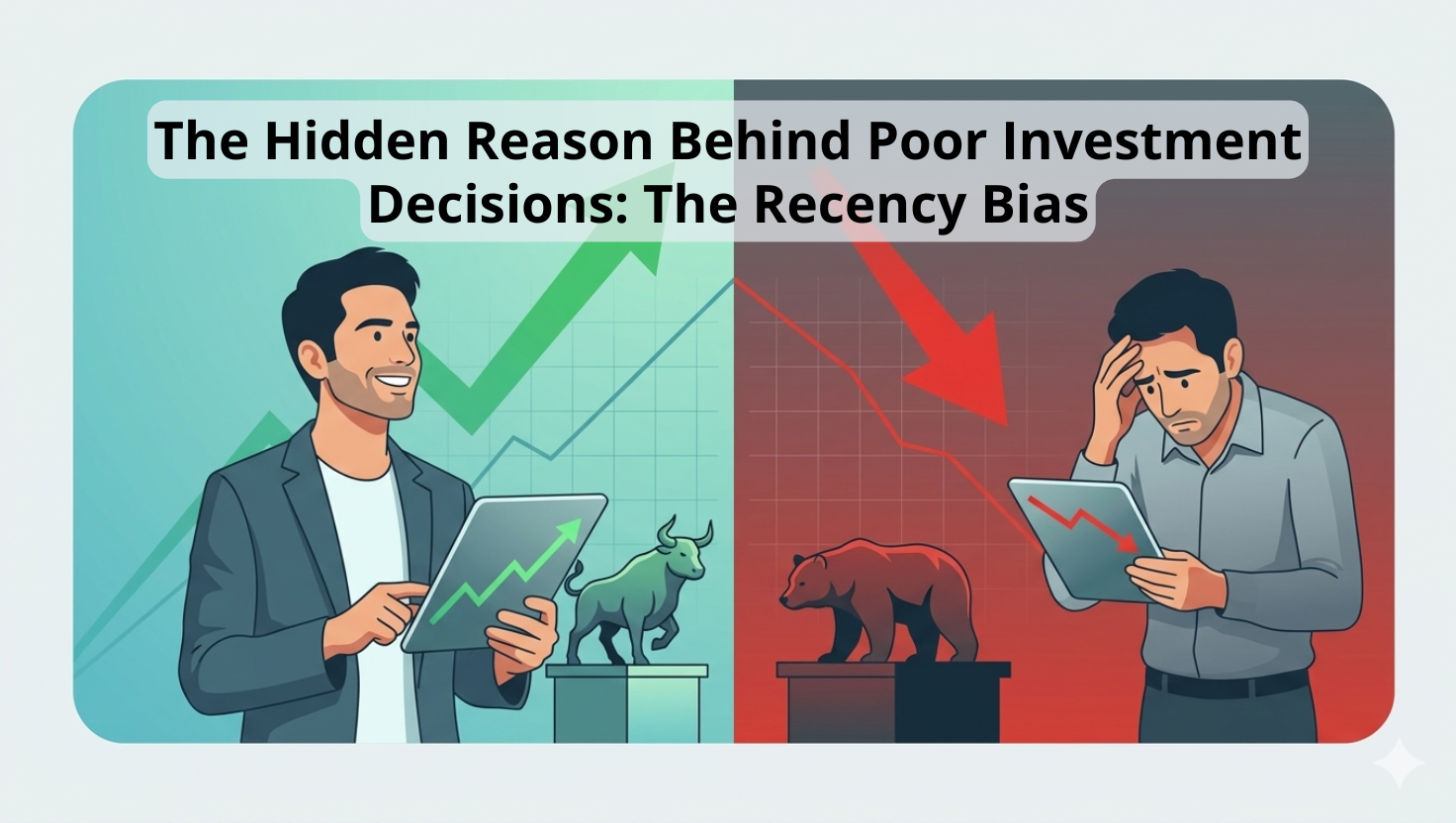
In money psychology there is a concept called “Recency Bias.” Recency bias is the tendency to give disproportionate importance to recent events while ignoring long-term patterns.
In investing, it often shows up as a simple but dangerous assumption: “What just happened will continue to happen.”
- After a rally, we expect high returns to continue
- After a fall, we expect further decline
These assumptions may feel natural. But they are often deeply misleading.
When Short-Term Experience Overrides Long-Term Reality
We understand that equity markets are inherently volatile in the short term, but reasonably consistent over longer periods. Historically, Indian equities have delivered ~10–14% annualised returns over long horizons.
But these returns do not come in a straight line. They are shaped by:
- Sharp corrections
- Unexpected recoveries
- Extended periods of sideways movement
Yet, many investors form expectations based on the last 12–24 months.
This leads to two common distortions:
- Overconfidence after rallies
When markets perform well, expectations quietly rise. A 12% expectation becomes 15%, then 18%, and sometimes even 20%.
- Doubt after corrections
When volatility returns, the same investors begin to question the asset class itself often leading to premature exits.
Recency bias changes behaviour too:
- Increasing allocation after strong performance
- Reducing exposure after corrections
- Entering at higher valuations
- Exiting during uncertainty
This quietly erodes long-term wealth.
A More Disciplined Way to Think About Markets
If markets are cyclical, our expectations cannot be linear. A few simple shifts can make a meaningful difference:
- Anchor to long-term data
Evaluate equity based on 10–15 year behaviour, not recent returns.
- Separate experience from reality
Understand that what you felt in the last year is not what markets are.
- Respect volatility as a feature, not a flaw
Volatility is the price paid for long-term returns, do not consider it as a signal to exit.
- Build asset allocation before performance
Asset allocation should be guided by your goals, time horizon, and risk appetite.
- Reduce decision frequency
The more often you evaluate, the more likely you are to react emotionally.
A Simple Self-Check
Ask yourself:
- Are my return expectations based on recent performance?
- Do I feel more confident investing after markets rise?
- Do I feel uncomfortable when markets fall, even if my goals haven’t changed?
If your answer is yes, recency bias may be influencing your decisions more than you realise.
Closing Thought
The market rarely misleads us. We often mislead ourselves by assuming that what just happened is what will keep happening.
And in investing, that assumption can be quietly expensive.

Shreedhara is the Founder & Director of Ara Financial Services Pvt. Ltd. He has an experience of over 2 decades in Financial Service Industry with majority of it in guiding individuals and institutions on their investments requirements.









1 thought on “The Hidden Reason Behind Poor Investment Decisions: The Recency Bias”
Panic don’t work in market fall. Long term thinking required. Nice experience based explanatory article by shreedhara. Very thoughtful….