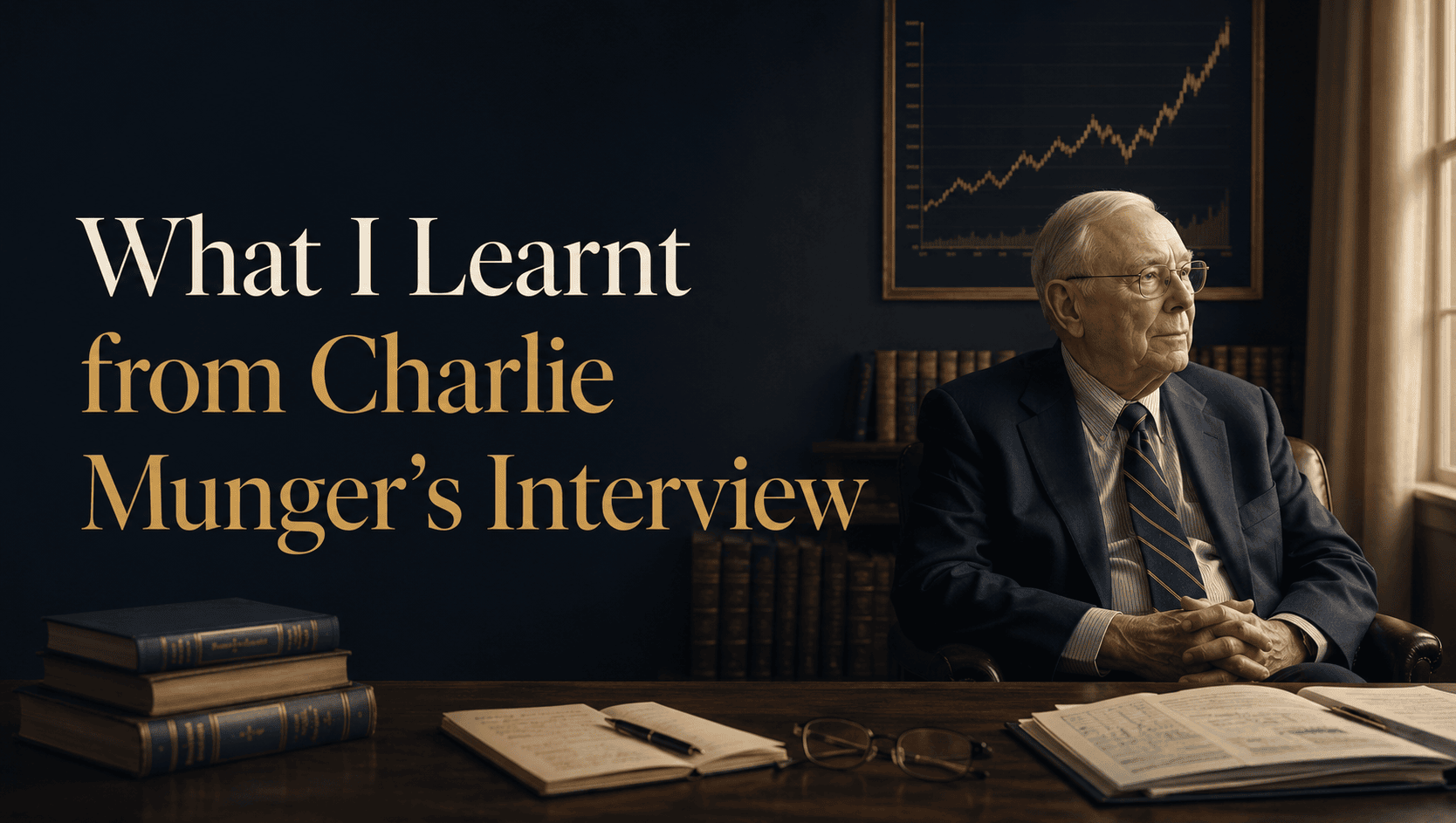
A few days ago, I came across an old interview of Charlie Munger in the Harvard Law Bulletin. In this interview, he spoke about money, business, and life in a way that felt grounded and deeply human.
It was published in 2001, but as I read through it, I realised that good ideas never become old. Some of the lessons he shared more than 25 years ago are relevant even today, even though he is now a part of history.
One of the first things that caught my attention was his belief that ethical conduct leads to good outcomes. In a world where we often hear stories of shortcuts, quick profits, and overnight success, Munger’s view was refreshingly different. He said that people who combine ethics with competence tend to do better in the long run.
As someone who works in financial services, I can relate to this idea. Trust is not built in a day. It is earned through hundreds of small actions and honest conversations. The wealth we build for our clients is important, but the trust they place in us is even more valuable.
Another lesson that stayed with me was his advice to view a stock as ownership of a business. It sounds simple, but I don’t think many of us understand it. As investors, we track stock prices every day, celebrate when they go up, and worry when they go down. Munger reminds us to look beyond today’s market price and ask a more important question of “Would I be happy owning this business?”
In fact, patience was the strongest theme throughout the interview. Munger spoke about waiting for the right opportunities and acting only when you have an advantage.
This idea felt particularly powerful to me because the gadgets, social media, newspaper encourages constant action. We feel the need to check, react, trade, and do something all the time. But I have observed that success is not always about doing more. Maybe it is about doing fewer things but doing them well.
The interview also reminded me that learning from many fields like history, psychology, science, and human behaviour is also a must to grow in the field of finance. Best decisions often come from understanding how the world works and not just from studying financial statements.
The interview also reminded me that while markets, geopolitical situations, and trends may change, the principles that create lasting success remain remarkably constant.
As we know, Charlie Munger was Warren Buffett’s long-time business partner and a remarkable stock picker. He had the ability, temperament, and patience to analyse businesses deeply, make informed decisions, and stay invested through market cycles. Over the decades, this discipline helped him build enormous wealth.
In many ways, mutual fund investors are in a safer position when compared to individual stock investors. The responsibility of selecting businesses rests with professional fund managers who specialise in research, operate within a strong regulatory framework, and have a fiduciary responsibility towards investors.
History shows that investors who stay invested in diversified mutual fund schemes (excluding specialised sectoral and thematic funds) have generally earned good long-term returns. However, this is possible only if they avoid reacting emotionally to short-term market movements. Many investors interrupt their own wealth creation journey by making decisions driven by fear or excitement. Sometimes, the most powerful investment strategy is simply to remain patient and allow time to do its work.
As I finished reading, I realised that Munger’s lessons apply to careers, relationships, parenting, and life itself. Be ethical, keep learning, think independently, and be patient.
In this age of information overload, revisiting such timeless ideas can prove to be invaluable.
Disclaimer: Ara Financial Services Pvt. Ltd. is an AMFI – Registered Mutual Fund Distributor (ARN – 76035). The purpose of this blog is to educate public on topics around personal finance, mutual funds & investing. The scenarios mentioned in the blog are to help readers understand the concept clearly. Do not treat our blogs as investment advice or an invitation/recommendation to invest in mutual funds or capital market or take any investment decision. Ara, its employees or the author cannot be held liable for any investment decisions taken on basis of the information in the above blog/article or any other reasons. Please consult an investment advisor or a mutual fund distributor for all your investment needs.

Shreedhara is the Founder & Director of Ara Financial Services Pvt. Ltd. He has an experience of over 2 decades in Financial Service Industry with majority of it in guiding individuals and institutions on their investments requirements.