
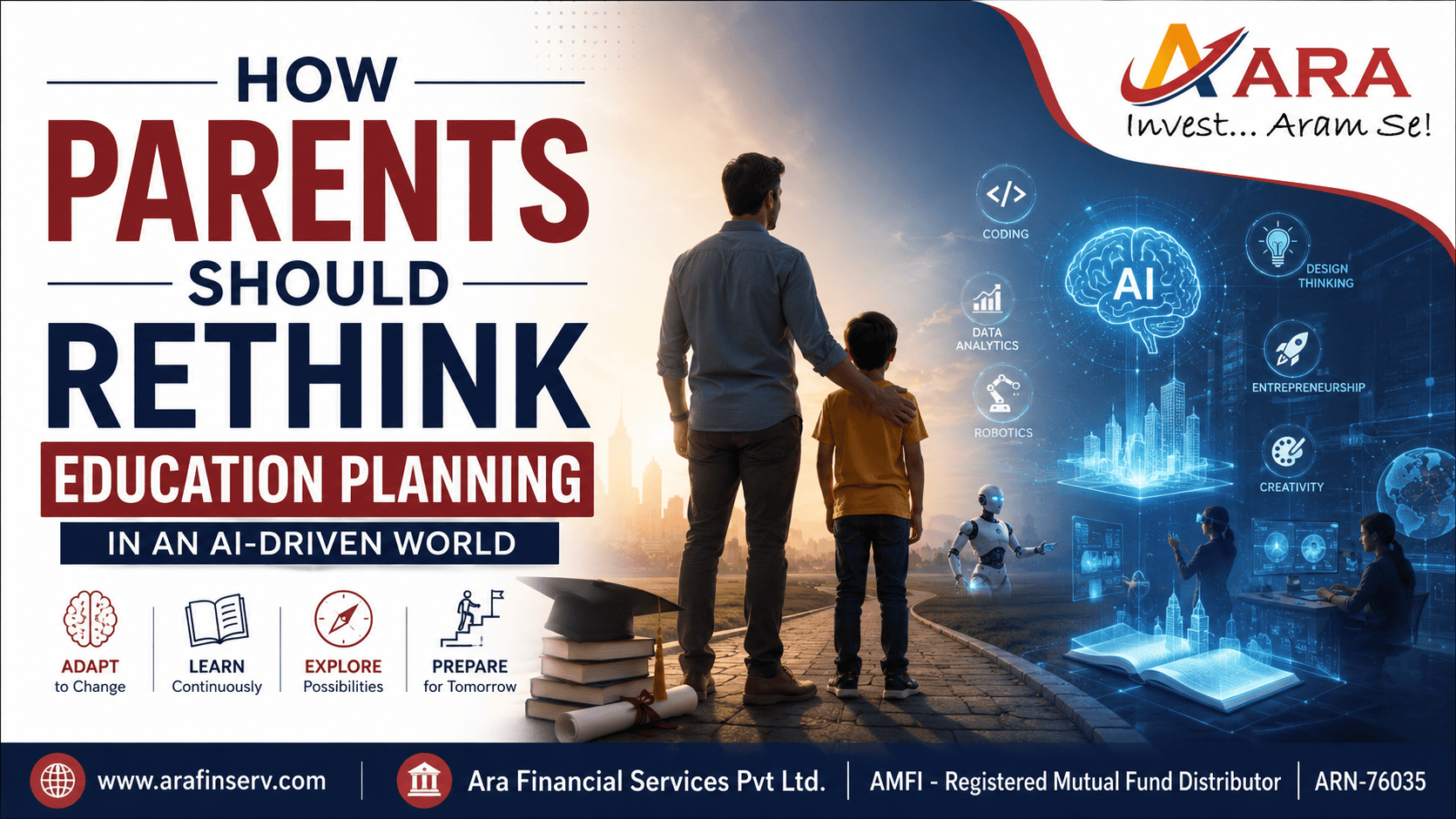
Imagine asking your great-grandfather what he wanted his children to become.
The answer would probably have been simple.
For many families, children continued in the family occupation. Agriculture. A local trade. A small business. Work was often determined by geography, community, and circumstance.
Then the world slowly began to open up.
People started leaving their villages in search of opportunities in nearby towns and cities. For many families, simply securing a stable source of income became progress.
Then came the era of the government job.
For an entire generation, a secure government position became the gold standard of success. Stability mattered more than anything else.
Later, India’s industrial growth created opportunities in public sector undertakings, manufacturing units, and private enterprises.
As the economy expanded, careers became increasingly mobile. People moved across districts, states, and eventually across countries in pursuit of better opportunities.
Then came liberalization.
Then the IT revolution.
Engineering became the dream. Computer science became the ticket to upward mobility. The world rewarded those who could write code, build software, and participate in the global technology boom.
Every generation prepared their children for the world they had known.
The challenge is that the world our children will enter may look very different from the one we know today.
And the world may change faster than any period in modern history.
Recently, India’s Chief Economic Advisor Mr. Ananth Nageswaran highlighted that the automatic preference for software, computer science, and MBA degrees may not be the obvious path to success in the future.
Whether that prediction turns out to be completely right is almost beside the point.
The more important message is that the future is becoming harder to predict.
A few quarters ago, Dr. Sanjeev Sanyal spoke about how education itself may need to evolve. Instead of spending years sitting inside classrooms consuming information, future education could become more modular, flexible, and skill oriented. Individuals may continuously acquire new skills, certifications, and even multiple qualifications throughout their careers.
Think about that for a moment.
For decades, education was viewed as something you completed before starting your career.
Tomorrow, education may become something you repeatedly revisit throughout your life.
The line between learning and working may begin to disappear.
Around the same time, Alphabet CEO Sundar Pichai delivered a commencement address at Stanford that carried an equally important message. He reminded graduates that they are the most prepared class today—until the next batch arrives.
The statement sounds simple. But the implication is profound. The pace of change that feels fast today may look slow a few years from now. Technology is not merely changing industries. It is changing the speed at which industries change.
This creates a dilemma for parents. How do you prepare a child for a future that nobody can clearly see? The answer may not be to predict more accurately. It may be to become more comfortable with uncertainty.
Many parents still approach education with a fixed destination in mind.
“My child will become an engineer.”
“My child will pursue medicine.”
“My child will do an MBA.”
The reality is that a child born today may work in industries that do not yet exist, use technologies that have not yet been invented, and acquire skills that are not currently taught in schools.
Trying to predict the exact path may be futile. Preparing for multiple paths may be far more sensible. This requires a subtle but important shift in thinking.
Previous generations prepared children for a profession. Future generations may need to prepare children for adaptation.
The objective may no longer be to acquire one qualification and build an entire career around it. Instead, it may be to continuously learn, unlearn, and relearn as the world evolves.
Ironically, this uncertainty does not make preparation less important. It makes it more important.
Because while nobody knows what form education will take fifteen years from now, one thing is certain: opportunities will continue to belong to those who are prepared to seize them.
The degree may change.
The institution may change.
The duration of learning may change.
Even the definition of education may change.
But the need to invest in human potential is unlikely to disappear.
Perhaps that is the real lesson for parents.
Don’t become overly attached to a specific degree, profession, or career path.
The world has changed too often for that.
Instead, focus on creating an environment where children have the freedom to explore, adapt, and pursue opportunities that make sense in their time, not ours.
After all, every generation inherits a world different from the one their parents prepared for.
This generation may simply inherit a world that changes much faster.
And perhaps that is what education planning will mean in the years ahead – not preparing a child for one destination but ensuring they have the freedom to choose from many.
The most valuable thing we can give our children may not be a particular degree, skill, or profession.
It may simply be the ability and the opportunity to adapt.
Disclaimer: Ara Financial Services Pvt. Ltd. is an AMFI – Registered Mutual Fund Distributor (ARN – 76035). The purpose of this blog is to educate public on topics around personal finance, mutual funds & investing. The scenarios mentioned in the blog are to help readers understand the concept clearly. Do not treat our blogs as investment advice or an invitation/recommendation to invest in mutual funds or capital market or take any investment decision. Ara, its employees or the author cannot be held liable for any investment decisions taken on basis of the information in the above blog/article or any other reasons. Please consult an investment advisor or a mutual fund distributor for all your investment needs.
Pratik Vora is a Certified Financial Planner and Associate Partner at Ara Financial Services. He has more than two decade’s experience in Banking & Financial Services Industry.







6 thoughts on “How Parents Should Rethink Education Planning in an AI-Driven World”
Every parent should do investment when the day of their child born. Because they get the horizon of extra years and extra compound to get more returns in the world.
Absolutely true!
Very aptly put forward Mr Pratik. When I look back in the context each word of your blog is reflected. We have seen as parents things changed and now seeing how things are changing for children growing up. I agree with you and I believe with horizon of wide options there is no tailored professional readiness and better to be prepared for adaptability. Each generation have own challenges.
Thank You, Mr. Atul. Yes, adaptability is what we all need to prepare the next generation for.
Right message from your article. Appreciate. Adaptability and ability to change, maturity to handle situations should be part of education. These will generally comes/experienced/learned in process of pursuing Good PG or professional degree. Hence child should encouraged to pursue their interest under proper guidance. Sky should be limit in deciding interest.
Thanks