
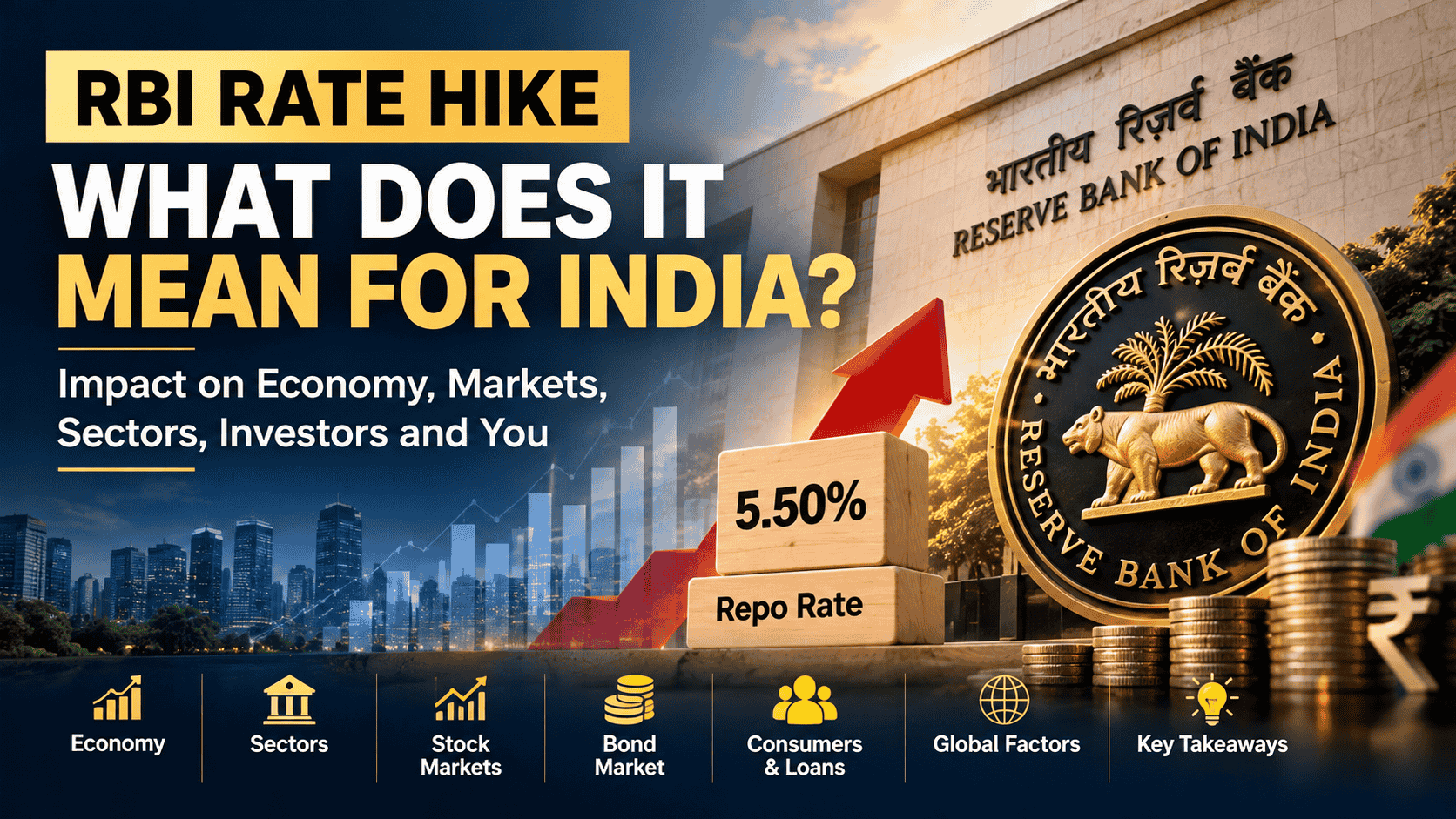
The Reserve Bank of India (RBI) has raised the repo rate by 25 basis points, from 5.25% to 5.50%. This is the RBI’s first rate hike since February 2023. The period since then has also been uncertain globally, with even Japan moving out of its negative-interest-rate regime into positive rates after three decades. Through this period of heightened uncertainty, the RBI has handled the situation sensibly.
More importantly, the Monetary Policy Committee (MPC) has changed its stance from “neutral” to “calibrated tightening.”
So, should we worry?
Not necessarily. The more important message is not the 25-basis-point hike itself, but what it tells us about the RBI’s thinking. The RBI is becoming more concerned about inflation and is no longer comfortable assuming that the recent price pressures will disappear on their own.
Why did the RBI hike rates when growth is strong?
At first glance, the decision may appear contradictory. The RBI has actually raised its FY27 GDP growth forecast from 6.7% to 7.1%, with stronger projections for the second and third quarters. India’s Q1 FY27 GDP growth was also a healthy 7.8%, supported by consumption and investment.
The problem is inflation.
The RBI has raised its FY27 inflation forecast to 5.2%, while expecting CPI inflation to average about 5.8% over the remaining three quarters. Core inflation is also projected at 4.4%.
India’s inflation target is 4%, with a tolerance band of 2%-6%.
The RBI is therefore trying to prevent a situation where higher oil, food and input costs become embedded more broadly into the economy.
And there is another major concern: crude oil.
Brent crude has been trading around or above $100 a barrel, significantly higher than the RBI’s earlier assumption of $85. The continuing conflict in West Asia, supply disruptions and a weaker rupee increase the risk of imported inflation. Along with this, the potential impact of a very strong El Nino (Super El Nino) on food prices also adds up to this.
What does this mean for the Indian economy?
A rate hike makes money slightly more expensive.
Higher interest rates can eventually slow borrowing, housing demand, automobile purchases and some forms of consumption and investment. In that sense, rate hikes are a brake on the economy.
But the RBI currently has some room to apply that brake because economic activity remains resilient. That explains why the RBI can simultaneously raise rates and raise its growth forecast.
The objective is not to stop growth. It is to prevent inflation from becoming persistent while keeping growth reasonably strong.
Which sectors will feel the impact?
The most sensitive sectors are banks, NBFCs, real estate and automobiles.
For real estate and autos, higher loan rates can make purchases less affordable and potentially delay new borrowing.
NBFCs may also face pressure because their funding costs can rise, although the impact will vary by business model and balance-sheet strength.
Banks are more complicated. Higher lending rates can support interest income, but banks may also have to pay more to attract deposits. So the impact on profitability will depend on how quickly lending and deposit rates move.
Consumer-facing sectors such as discretionary retail and some durables could also feel pressure if households become more cautious about taking loans.
What about the stock market?
The immediate market reaction has been negative, but that does not necessarily mean a prolonged correction.
The 25-bps hike was largely expected and therefore already factored by the market. What surprised investors more was the change in stance to calibrated tightening and the indication that near-term rate cuts are off the table.
Rate-sensitive stocks and sectors have been under pressure, while markets are also reacting to crude prices, the rupee and high US bond yields.
For equities, the environment is therefore changing from “lower rates can support valuations” to “earnings will need to justify valuations.” Companies with strong balance sheets, pricing power and sustainable earnings growth could become more attractive in such an environment.
What happens in the bond market?
Bond prices and bond yields move in opposite directions.
When markets expect interest rates to remain higher for longer, bond yields generally move up and existing bond prices come under pressure. The Indian 10-year government bond yield was already around 7.2% ahead of the policy decision, reflecting expectations of tighter monetary conditions.
For debt investors, this means the direction of interest rates matters more than a single 25-bps move. A prolonged tightening cycle can create short-term volatility in longer-duration bonds, while shorter-duration instruments may be relatively less sensitive.
What does it mean for consumers and borrowers?
This is perhaps the most direct impact.
Loans linked to external benchmarks are likely to become more expensive. Home loans, auto loans and personal loans could see higher interest rates, which means higher EMIs or a longer repayment period. MCLR-linked loans may also become costlier, although the timing and extent will depend on individual banks.
The positive side is that deposit rates and fixed-deposit returns may also gradually move higher as banks compete for deposits.
What could determine the next RBI move?
This is where the real uncertainty lies.
The RBI Governor has clearly indicated that near-term rate cuts are off the table and that the next move is likely to be either a hike or a pause, depending on incoming data.
Three things will be particularly important: crude oil prices, the rupee and global interest rates.
A prolonged West Asia conflict could push oil higher, increasing India’s import bill and inflation. A further rise in US bond yields or another tightening move by global central banks could put pressure on the rupee and foreign capital flows. Trade disruptions, food inflation and weather-related shocks(impact of El Nino on Kharif crop) could add further complications.
The bigger message
The RBI has not slammed the brakes on the economy. It has simply become more cautious.
Growth is still strong. Inflation, however, is becoming a bigger concern.
For consumers, borrowing may become more expensive. For companies, the cost of capital could rise. For bonds, yields may stay elevated. For equities, easy liquidity may no longer provide the same support to valuations.
For investors, the key takeaway is simple: do not focus only on today’s 25-bps hike. Watch the direction of inflation, crude oil, the rupee, global interest rates and corporate earnings.
The 25 bps is the headline. The real story is the RBI’s shift in stance, from supporting growth to guarding against inflation.
Should long-term investors change their strategy? Largely, no. Stay with your asset allocation, but be prepared for a phase of lower and more volatile returns, and keep investing through SIPs, which spread your purchases across market cycles and help you accumulate more units when valuations are under pressure.
Ara Financial Services Pvt. Ltd.
AMFI-Registered Mutual Fund Distributor | ARN-76035
APMI – Registered PMS Distributor | APRN02933
Mutual Fund investments are subject to market risks. Please read all scheme related documents carefully before investing. The views expressed in this article are educational in nature and should not be construed as personalised investment advice or as a recommendation to buy, sell or hold any security or scheme. Past performance may or may not be sustained in future.

Pratik Vora is a Certified Financial Planner and Associate Partner at Ara Financial Services. He has more than two decade’s experience in Banking & Financial Services Industry.