
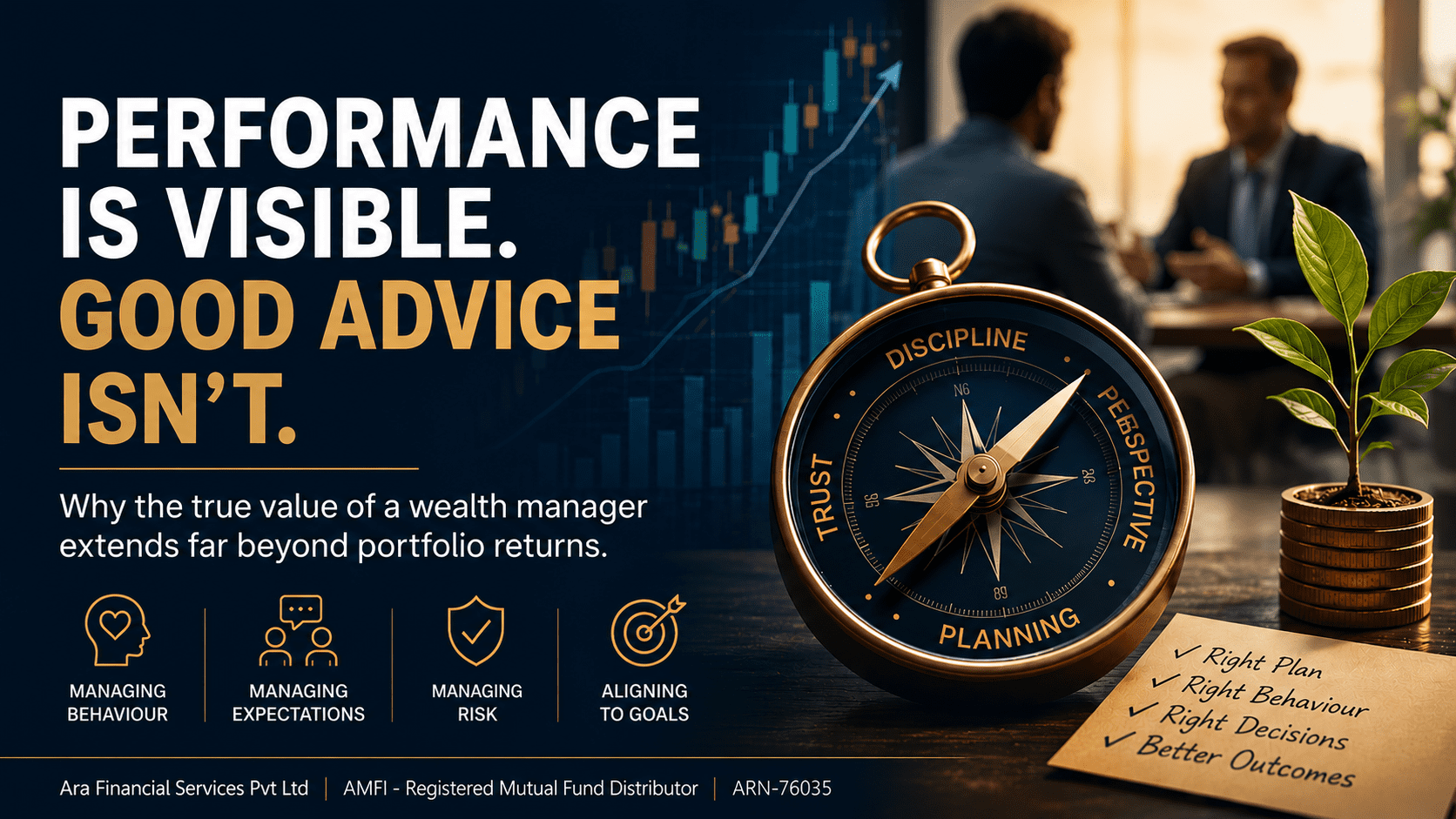
Why the true value of a wealth manager extends far beyond portfolio returns
Most investors judge their advisor by returns alone. While performance is important, true wealth management is equally about managing behaviour, expectations, emotions, and long-term discipline. This article explores the often-invisible value a trusted wealth professional brings to an investor’s financial journey.
Returns do matter, and they always will. Yet, in my experience of more than two decades, one of the biggest misconceptions investors make is evaluating their financial advisor solely through the lens of portfolio performance.
If the numbers look impressive, the advisor is considered competent. If returns lag for a few quarters, questions begin to arise. Eventually, almost every conversation comes down to a single question: “How much return did I get?”
Whether the investment is in mutual funds, stocks, structured debt, international funds, GIFT City investments, PMS, AIFs, venture capital funds, or private equity, performance becomes the primary yardstick. While returns are undoubtedly important, reducing the profession of wealth management to product performance alone is a dangerous oversimplification that can ultimately work against an investor’s long-term interests.
Wealth Management Is About People Before Portfolios
Managing money is, in many ways, a structured exercise. There are well-established principles, sensible asset-allocation frameworks, and logical ways of matching investments to financial goals and time horizons. Every product behaves differently across market cycles.
The difficult part is not selecting investments—it is managing the emotions attached to them.
Fear during market corrections, excitement during bull runs, impatience when goals seem distant, and overconfidence after periods of strong performance often influence financial outcomes far more than the investments themselves.
A good advisor therefore does much more than recommend products. They create an environment where investors feel comfortable discussing ideas, asking questions, expressing concerns, and making informed decisions. They help clients remain committed to long-term goals even when short-term emotions suggest otherwise.
The Invisible Value
In reality, wealth managers handle expectations, emotions, ambitions, dreams, uncertainties, and family conversations alongside financial assets. They safeguard confidential financial information and earn trust through discretion and integrity.
This is where fiduciary responsibility becomes especially meaningful. At its core, it represents the responsibility to place a client’s interests above everything else. It is both an ethical commitment and, in many situations, a legal obligation.
An Evolving Profession
The role of today’s wealth manager is very different from what it was a few decades ago. Investors now have access to enormous amounts of information almost instantly. While this has improved transparency, it has also increased noise. Social media narratives, market commentary, short-term comparisons, and viral opinions constantly influence investor behaviour.
Consequently, today’s advisor is expected to educate clients, communicate risks honestly, manage expectations realistically, guide investors through volatile markets, structure portfolios tax-efficiently, facilitate intergenerational wealth transfer, discuss succession, nominations, and wills sensitively, and help families navigate difficult financial conversations.
Many of these responsibilities remain invisible because they cannot easily be measured.
What Investors Often Overlook
Portfolio returns are visible. Performance reports can be compared. Underlying investments can be analysed.
Behavioural coaching, emotional discipline, thoughtful conversations, and the confidence to stay invested during uncertainty are far harder to quantify. Ironically, these often become the biggest contributors to long-term wealth creation.
Experienced investors understand this. They evaluate their advisor not only on returns but also on communication, integrity, consistency, crisis management, and the ability to help them make better financial decisions over decades.
Questions Worth Asking
Instead of asking only, “What return did this investment generate?”, investors may also ask:
• Did my advisor help me avoid emotional mistakes?
• Was I educated rather than merely sold products?
• Did my advisor remain accessible during difficult periods?
• Did they challenge my decisions when necessary?
• Did they consistently act in my long-term interest?
The answers to these questions often reveal the true quality of an advisor far better than a one-year performance statement.
Final Thought
Returns are an outcome. Behaviour is a process.
While markets will continue to rise and fall, investors who remain disciplined through changing market cycles are more likely to achieve their long-term goals than those who constantly chase the latest top-performing investment.
Ultimately, the true value of a wealth manager lies not merely in helping clients earn higher returns, but in helping them make better financial decisions, remain emotionally balanced, and build lasting financial confidence. In the end, peace of mind may well be the most valuable return of all.

Shreedhara is the Founder & Director of Ara Financial Services Pvt. Ltd. He has an experience of over 2 decades in Financial Service Industry with majority of it in guiding individuals and institutions on their investments requirements.








4 thoughts on “Performance Is Visible. Good Advice Isn’t.”
Well meaning article. The advisor’s true role well explained.
Thank You, Mr. Misra. We are glad you liked this article.
The advisor has his own risk and mangement about the second changes in the market to deliver to customer and convince is more important.
Thank you
Thanks.