
I hear this frequently. How will I know when is the best time to enter the market? I have always wanted to answer this in a way that shifts the focus from “time to market” to “time in the market.” So, I decided to let the data do the talking. Let’s look into some interesting data.
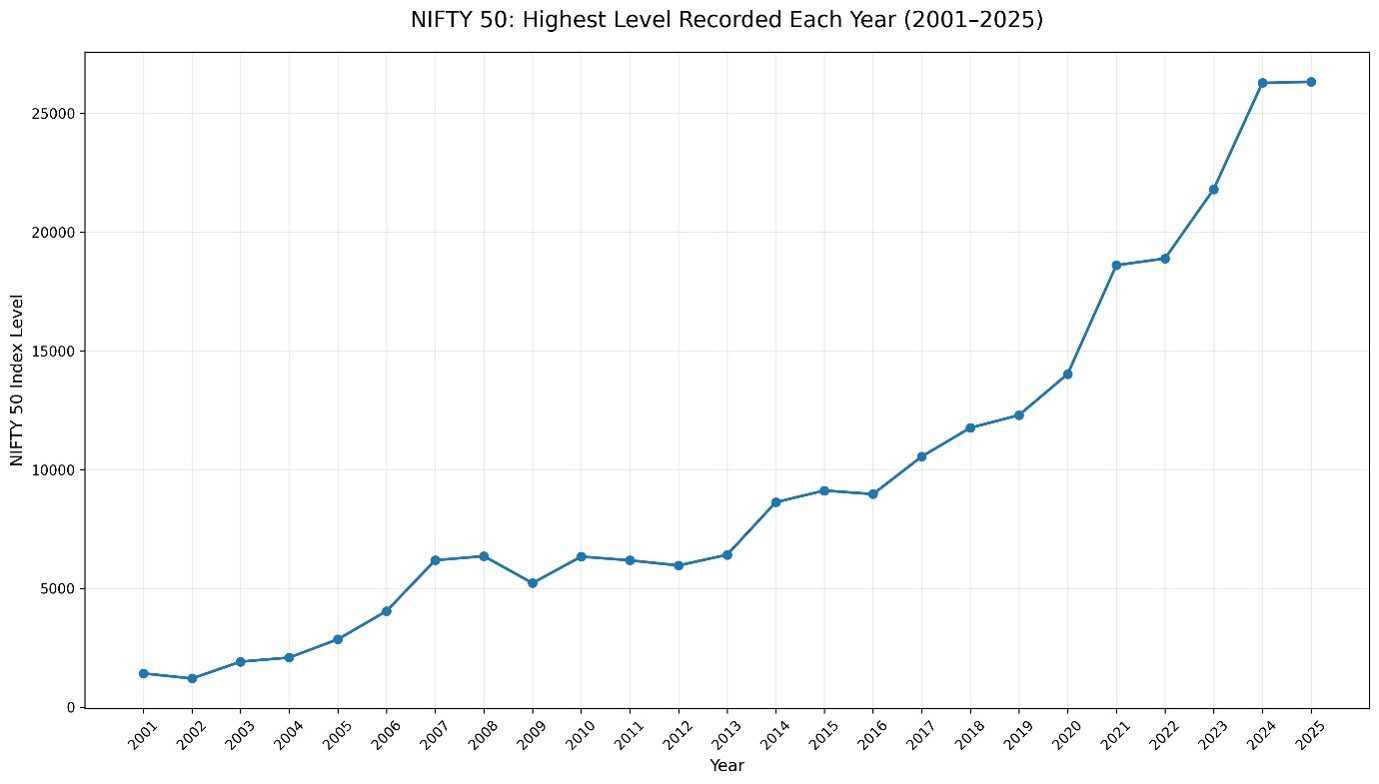
Every year, Mr. Akash decides to invest ₹10,000 in the market. But there is one problem. He never gets a good entry point. He invests at the highest level of the Nifty 50 for that entire year. He buys when the market is at its yearly peak.
And he does this every year for 25 years, from 2001 to 2025.
Sounds like a terrible investment strategy, doesn’t it?
Let’s call Akash the Unluckiest Investor.
The total amount invested over 25 years would be: ₹10,000 × 25 = ₹2.50 lakh.
You might expect Akash to have done poorly. After all, he bought at the top every single year.
But data tells a very different story.
Using the annual Nifty 50 highs for each year and looking at the value at the end of 2025, the ₹2.50 lakh invested over these 25 years would have grown to approximately ₹13.5 lakh. That is more than 5 times the total amount invested delivering an XIRR of approximately 11.84% returns per annum.
And remember, this investor supposedly had the worst possible entry timing every year.
The annual highs used in this illustration range from around 1,423 in 2001 to 26,326 in 2025. Historical NSE data and published historical datasets show how dramatically the index moved over these years.
You might be thinking, but didn’t he buy at the top?
Yes. He did. When we look at markets today, an all-time high often feels like a warning sign. You hear: “The market has gone up too much.” “I’ll wait for a correction.” “Let the market fall 10%, and then I’ll invest.” “This doesn’t feel like the right time.” These thoughts are understandable.
Nobody wants to invest ₹5 lakh today and see it become ₹4.5 lakh next month. But there is a problem with waiting for the “perfect” entry. You don’t know when it will come.
More importantly, you don’t know whether the market will fall after you invest or rise another 10%, 20%, or 30% before the correction you were waiting for arrives.
Let’s look at the Nifty 50.
The index crossed 6,000 in 2007, fell dramatically during the global financial crisis, recovered, crossed 10,000, then 15,000, 20,000, and eventually crossed 26,000. The journey was anything but smooth. Yet the long-term trend has been remarkably upward.
The Cost of Waiting
Suppose you had decided in 2014 that the Nifty was “too expensive.” You waited. The market kept rising. Then in 2017, you thought, “Surely a correction is coming.” You waited again. In 2020, the market crashed. But probably this was a time when you felt the most uncertain about whether to invest or wait.
Finally, you thought, “Now I’ll invest!” But by the end of 2020, the Nifty had recovered sharply from its March lows. The perfect opportunity you were waiting for was visible only after it had passed. This is the problem with trying to time the market.
What About Someone Who Invested Regularly?
Our “Unluckiest Investor” didn’t worry about whether the market was at an all-time high. He didn’t wait for crashes. He didn’t try to predict the next correction. He simply invested regularly.
Over a long enough period, his money got exposed to different market conditions of highs, lows, corrections, crashes, and recoveries. His money took real advantage of long-term disciplined investing.
The Nifty 50’s long-term history is a good reminder of this. The index has experienced severe falls but has repeatedly gone on to make new highs.
The Lesson
This does not mean you should blindly invest all your money at any market level. Asset allocation, risk profile, investment horizon and financial goals still matter. And past performance is certainly not a guarantee of future returns. But there is an important behavioural lesson here.
A bad entry point is not necessarily a bad investment decision. Sometimes, the bigger mistake is having money sitting on the sidelines for years because we are waiting for a better day.
The market volatility will always give us reasons to wait. But nobody rings a bell to announce the perfect entry point. So don’t think of a perfect time to invest; just invest in a way that gives your money enough time to grow.
Over 25 years, even Mr. Akash, who bought at the akash point (top point) every single year, still ended up with substantially more wealth than the ₹2.5 lakh he invested.
*Data note: This illustration assumes ₹10,000 invested once every year at the peak value of Nifty 50 for the respective calendar year from 2001–2025 and values the accumulated units at the 31 December 2025 Nifty 50 closing level of 26,129.60. The calculation is an illustrative index-based exercise and does not include dividends, taxes, costs, or mutual-fund tracking differences. Actual investment returns will vary. Historical annual highs are drawn from published NSE/historical datasets.

Shreedhara is the Founder & Director of Ara Financial Services Pvt. Ltd. He has an experience of over 2 decades in Financial Service Industry with majority of it in guiding individuals and institutions on their investments requirements.