

Today, I had an interesting conversation with my customer, Ajith. He has been associated with us for a little over six years and has been remarkably disciplined with his SIPs.
Ajith: I am bored with SIPs. I don’t see any real growth. It feels like I’m just throwing money into a black hole every month.
Me: Ajith, let me tell you a story. Pull up a chair.
Ramu was a farmer. One fine morning, he decided to plant a coconut sapling in his backyard.
He bought the healthiest sapling he could find, carefully chose the right spot, prepared the soil, and planted it with great hope. Every day, he watered it. He added compost whenever required and protected it from grazing cattle. He did everything a good farmer was supposed to do.
One year passed.
The tiny sapling had grown into a healthy young plant. But there were no flowers. No coconuts. Just leaves.
Another year went by. Still nothing.
By the third year, his neighbours had started laughing. They told him he was wasting valuable space and should replace the coconut tree with something that would produce results quickly. But Ramu ignored them and continued to care for the plant.
As the years passed, the tree grew taller and stronger. More importantly, its roots were spreading deep into the ground, unseen by anyone.
Then one day, the first flowers appeared.
Soon after came the first bunch of tender coconuts.
From that point onwards, every season brought more fruit. The same tree that had seemed disappointing for years went on to reward him for decades.
Ajith: That’s interesting… Go on.
Me: Ajith, that coconut tree is exactly like your SIP.
And then I explained an interesting observation about compounding that is called as the 8-4-3 Rule.
Imagine you invest ₹20,000 every month through a SIP.
Assuming a long-term return of 12% per annum, your investment grows to about ₹32.3 lakh over the first eight years.
At first glance, it doesn’t look extraordinary.
Now watch what happens next.
During the next four years (Years 9 to 12), your portfolio adds another ₹32 lakh. In other words, it creates almost as much wealth in four years as it did during the first eight.
And then comes the most interesting phase.
Over the following three years (Years 13 to 15), your portfolio crosses ₹1 crore. Another ₹32 lakh gets added, but this time in just three years.
That is the 8-4-3 Rule.
Eight years to build the foundation.
Four years to gather momentum.
Three years to experience the real power of compounding, where your money starts working harder.
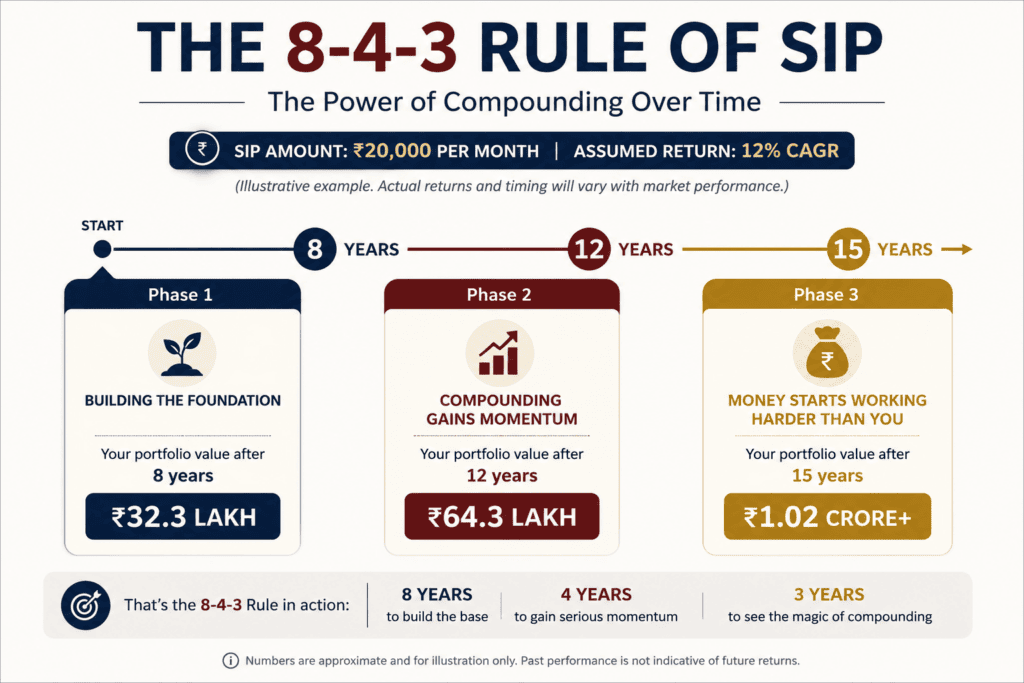
Of course, this is an observation based on how compounding has historically worked when markets have delivered around 12% annualised returns over long periods. In reality, the journey may be a little slower or faster depending on market conditions. The exact timeline can change a bit, but the mathematics of compounding remains the same.
Why Most People Miss the Miracle
Like Ramu, many SIP investors feel tempted to uproot their investment long before it has had the chance to bear fruit. Market corrections, alarming headlines, endless social media opinions, and the constant noise around them create the illusion that nothing is working.
In my experience of last 20 years, I have learnt that during the initial years of a SIP, most of the growth in your portfolio comes from the money you contribute every month. Compounding is already at work, but its impact is barely visible.
Then, somewhere around the eighth year and beyond, the equation begins to change. Your returns start earning returns of their own. Gradually, compounding shifts from being an invisible force to becoming the primary engine of wealth creation.
The investor who quits in the fourth or fifth year saying, “I don’t see much growth,” is no different from Ramu cutting down his coconut tree just before it begins to reward him for all the years of patience and care.
What Should You Do?
Start early.
Stay consistent. Don’t pause your SIPs just because markets have fallen.
Don’t watch your portfolio every day. A coconut tree doesn’t grow faster because you keep staring at it. Neither does your SIP. Review it periodically, not daily.
Most importantly, trust the process. The 8-4-3 Rule is not a promise. It is a reminder that compounding often looks ordinary before it starts looking extraordinary.
Coming back to Ajith, he isn’t completely convinced yet. But he has decided to continue for at least ten years.
I have a feeling that once he experiences compounding for himself, he won’t need another story from me and will continue until he reaches his financial goals.

Shreedhara is the Founder & Director of Ara Financial Services Pvt. Ltd. He has an experience of over 2 decades in Financial Service Industry with majority of it in guiding individuals and institutions on their investments requirements.