Artificial Intelligence is rapidly becoming part of everyday financial decision-making. From budgeting and tax planning to investment recommendations and portfolio analysis, technology is making financial information more accessible than ever before.
And that is unquestionably a good thing.
Lower costs, faster access to information and improved efficiency can help investors make better decisions. In many cases, AI can simplify processes that earlier required significant time, expertise or expense.
But somewhere in this discussion, an important distinction often gets overlooked:
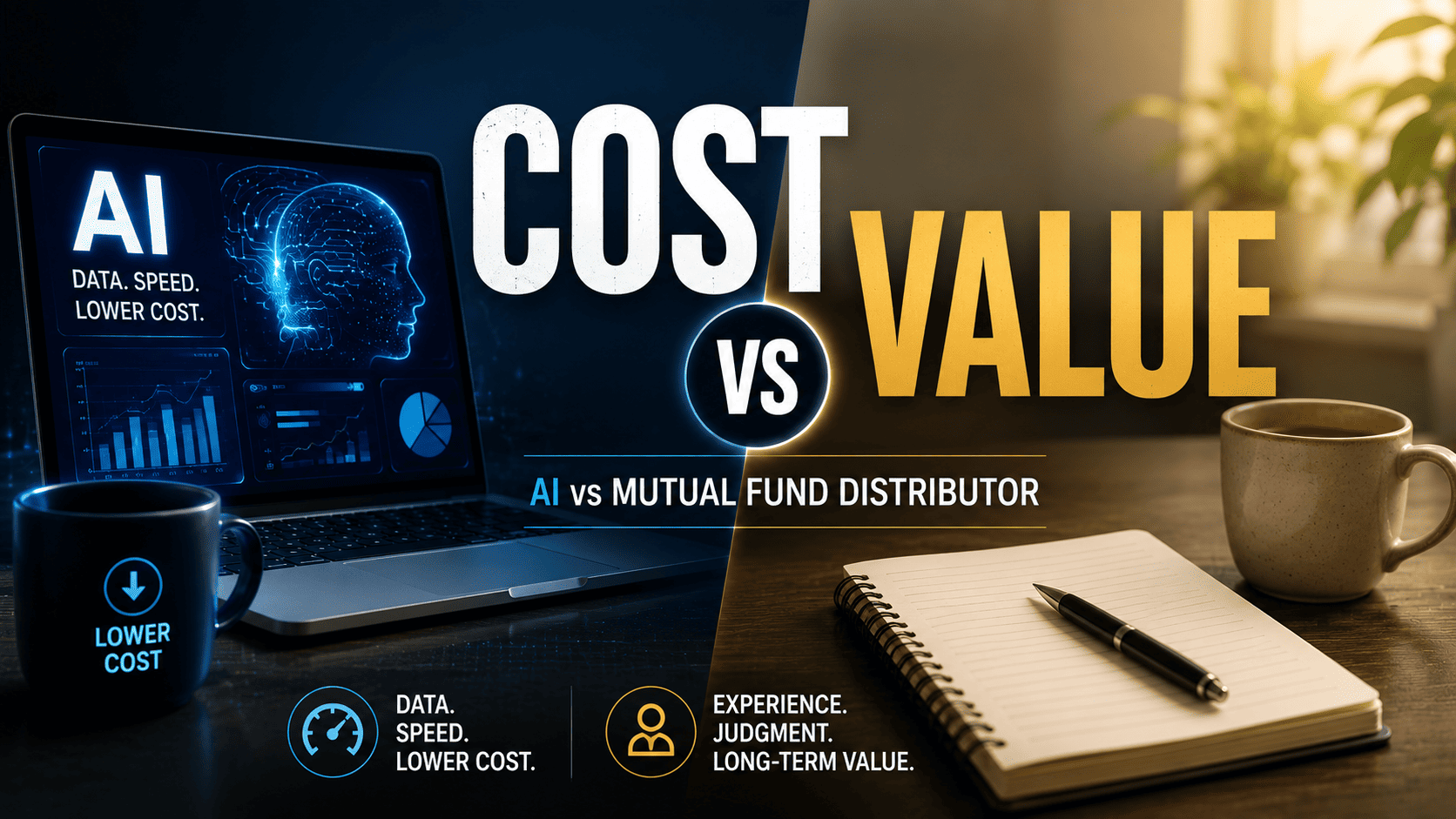
the difference between cost and value.
Cost is immediate and measurable. Value is often contextual and visible only over longer periods of time.
This becomes particularly relevant in financial advisory and mutual fund distribution, where conversations frequently revolve around fees, commissions and direct versus regular plans. The assumption is often straightforward: lower cost automatically means better outcomes.
In reality, financial outcomes are not driven only by products or percentages. Human behaviour plays an equally important role.
The Behaviour Gap in Investing
Most investment mistakes are rarely analytical mistakes. They are behavioural ones.
People do not usually struggle because information is unavailable. In today’s world, financial information is everywhere. What investors struggle with is consistency, patience, emotional discipline and decision-making during uncertainty.
Markets test behaviour far more than intelligence.
Investors may claim to have high risk tolerance during bull markets, only to become deeply uncomfortable during corrections. Many understand the importance of long-term investing in theory yet react emotionally to short-term volatility. Others abandon disciplined investing because of temporary pessimism, social influence or fear of missing out.
Where AI Excels and Where Human Advice Still Matters
This is where the conversation around AI versus human advice becomes more nuanced than a simple cost comparison.
AI can process enormous amounts of information quickly. It can compare products, summarize research, identify patterns and provide structured financial suggestions. It is already becoming an extremely powerful tool for both investors and advisors.
But financial decision-making is not always a purely mathematical exercise.
Two individuals with identical income, age and investment amounts may still require completely different approaches because their emotional relationship with money is different. One may prioritize security because of family responsibilities. Another may tolerate volatility comfortably. One may panic during uncertainty. Another may become overconfident during rising markets.
These behavioural dimensions are difficult to capture fully through prompts and data inputs alone.
More importantly, people themselves are not always fully aware of their own financial behaviour. Emotions often reveal themselves gradually through conversations, reactions, hesitation and lived experiences.
The Future Is Not AI or Advisor
This does not mean technology lacks value. In fact, the future of financial advice will almost certainly involve deeper integration of AI tools.
Advisors who ignore technology may eventually struggle to remain relevant. Clients are also justified in expecting greater transparency, efficiency and better service standards in an increasingly technology-driven environment.
At the same time, reducing financial advice to only a fee comparison may oversimplify the role that guidance, behavioural coaching and long-term accountability play in wealth creation.
The more relevant comparison may not be:
AI versus advisor.
It may eventually become:
AI-enabled advisor versus generic AI usage without context.
Because technology can improve decision-making, but it cannot always fully interpret human complexity, emotional inconsistency or behavioural biases in the way experienced human interaction sometimes can.
And in personal finance, behaviour often shapes outcomes more than information itself.
Cost Is Visible. Value Is Often Hindsight.
The larger point is not that one model is universally superior to the other. Both technology and human advice have strengths, limitations and evolving roles.
AI will undoubtedly democratize financial knowledge and improve access to guidance. That should be welcomed.
But while costs are easy to calculate, value is often understood only in hindsight.
Disclaimer: This article is published by Ara Financial Services Pvt. Ltd. (ARN-76035), an AMFI-registered Mutual Fund Distributor, for investor education and general informational purposes only. It is not investment advice or a recommendation to buy, sell or hold any investment product. Mutual Fund investments are subject to market risks, read all scheme related documents carefully. Please consult your financial and tax advisors before making any investment decision.

Pratik Vora is a Certified Financial Planner and Associate Partner at Ara Financial Services. He has more than two decade’s experience in Banking & Financial Services Industry.