
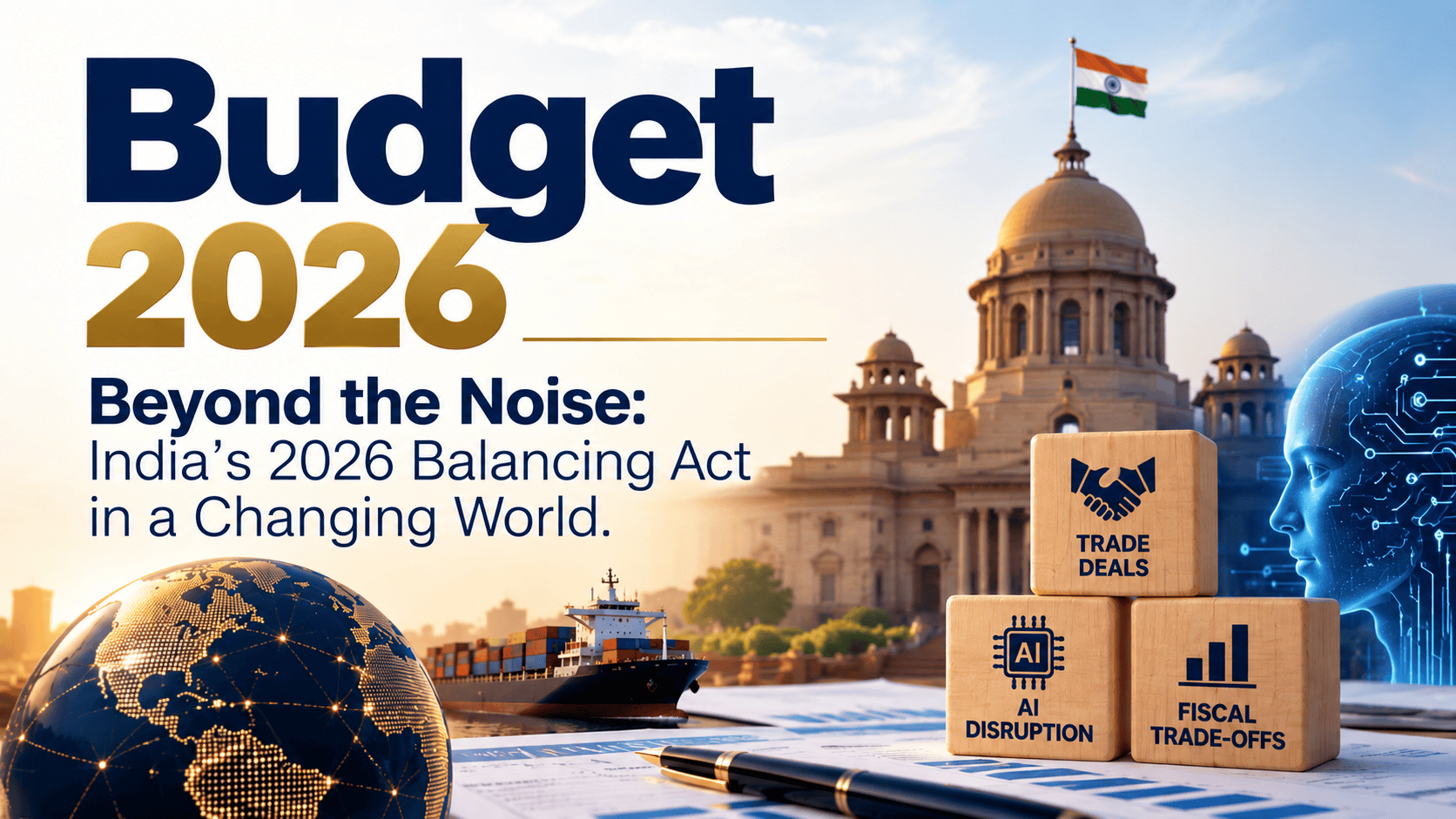
2026 has begun on an unusually eventful note.
A widely discussed Union Budget set the tone domestically. Simultaneously, after nearly 19 years of negotiations and intermittent pauses, the long-stalled Free Trade Agreement discussions with the European Union gained decisive momentum. The EU FTA, once considered politically and structurally complex, has moved forward in a manner which was unanticipated.
Almost in parallel, the possibility of tariff recalibrations or revised trade terms adds yet another dimension to an already evolving geopolitical landscape. In a span of just a few weeks, fiscal policy, long-pending trade negotiations, and energy diplomacy have all intersected. These developments prompted me to pause, reflect, and pen down these thoughts.
Let us start with the Budget 2026. Every Budget season follows a familiar script.
Capital market participants scan budget with a narrow lens expecting positive news for capital gain taxes, STT and related issues. Banks expect tax efficiency for Fixed Deposits to ensure low-cost capital flows. Individuals look for tax relief. Industries look for incentives. States look for higher allocations. Rural India expects subsidies. The wish list is endless.
Today we are seeing a new world order. The last half a decade was filled with consistent geopolitical events like wars, supply chain constraints, volatile commodity prices, central banks exploring alternatives to dollar. All of this, along with the noise around Artificial Intelligence, is reshaping the global landscape.
Somewhere between these competing expectations lies the Central Government’s real challenge of balancing growth, fiscal prudence, and political economy.
As every year, this noise was visible around the Budget 2026 too. STT became a major talking point post-budget, but the noise faded with the announcement of the EU FTA, even though its actual impact will only be visible after 2027, when it comes into effect. This was followed by the announcement of an interim trade deal between the US and India through an executive order awaiting President Donald Trump’s signature. However, the fine print regarding procurement of Russian oil is still unclear, leading to doubts about whether the order will be signed. And even if signed, whether it could be rolled back in the near future remains an ambiguity. This uncertainty will likely keep market movements dynamic and range-bound in the short term.
It is important, therefore, to step back and look at the broader picture not as traders, not merely as investors, but as neutral observers or from a policymaker’s perspective.
F&O, Retail Losses & Public Interest
One area that deserved attention in Budget 2026 is derivatives trading. Retail participation has exploded in recent years but so have the losses. The annual losses suffered by retail investors from F&O trading reached around ₹ 1 lakh crores, and the trend is getting worse. Hence the policy response on Increasing STT on F&O transactions is a welcome move. As the saying goes, a penny saved is a penny earned. Let us hope that this measure discourages reckless speculation.
STT, Capital Gains & the Uneasy Debate
One of the loudest narratives doing the rounds is the demand to abolish Securities Transaction Tax (STT) and/or a reduction in Capital Gain Tax. Even a member of the opposition in the Lok Sabha demanded for the complete removal of Capital Gain Tax. The argument, on the surface, sounds logical.
STT was introduced in 2004 as a substitute for capital gains tax. Today, both STT and capital gains tax exits.
However, even after these levies, India’s capital gains tax rates remain significantly lower than most large global capital markets. Additionally, capital gains up to ₹1.25 lakh per financial year remain tax-free.
This differential treatment is policy-driven designed to:
- Encourage financialisation of household savings
- Shift money from physical assets and unregulated avenues
- Reward long-term, inflation-beating investments
So, while market participants may feel the pinch, from a policy-maker’s perspective, the structure is still investor-friendly.
Recently, a senior banker from India’s largest public sector banks have highlighted a genuine concern. Fixed deposit interest is taxed at slab rates whereas Capital gains enjoy concessional taxation. Their argument is that this has led to a trend where people are shifting from Fixed Deposits to capital market products. This, along with lower interest rates, has made deposit mobilisation a big challenge for banks. Ironically, the banks themselves sell insurance and investment products to earn third party fee income that now forms as a meaningful portion of their total income.
This concern is valid but incomplete. As a country, we want households to invest smartly in regulated products with long-term orientation to earn returns that beat inflation. Penalising capital market investments to make fixed deposits attractive again would be a policy regression.
The real solution lies elsewhere:
- Better rural penetration by banks
- Gaining share presently going to cooperative institutions (where many depositors have lost money due to insolvency issues)
- Competing on service, not just on tax arbitrage
Tax Relief for the Masses: A Quiet but Powerful Shift
One of the most consequential shifts in recent budgets has been broad-based tax relief for the middle and lower-income groups. By widening slabs and rationalising rates, the government has:
- Reduced effective tax burden for a large section of taxpayers
- Increased disposable income
- Supported consumption without fiscal recklessness
This has had a cascading impact supporting small businesses, consumption-led growth, and financial stability. It is a structurally important move.
Unlike many global peers, India has managed inflation relatively well in recent years through targeted food price controls, GST rationalisation, and supply-side interventions. When compared globally where rate cuts have not seen impact at the ground level, the REPO rate reductions (1.25%) has actually translated to a massive savings of over ₹ 1 Lakh crore for the borrowers. Despite GST rate cuts, the monthly GST collections have grown, indicating an uptick in consumption. Regular GST collections have also ensured predictable fund flow to states, even as fiscal pressures rise.
States, Welfare & the Allocation Tug of War
State governments are increasingly vocal about:
- Higher allocations
- Greater autonomy
- Rising welfare implementation costs
Irrespective of the Govt in power, the freebie culture adopted by few states has strained their financial health prompting them to ask for a higher allocation for the state. However, as highlighted in the Economic Survey, it is clear that the resource allocation between the states is structured and data driven. Recent structural changes such as increased state participation in employment and rural schemes have shifted a part of the financial responsibility downward.
States are not wrong to demand clarity. But from a national balance sheet perspective, fiscal discipline cannot be outsourced or ignored.
Defence, Infrastructure & Capex: The Non-Negotiables
Over the last few budgets, certain priorities have remained consistent:
- Defence spending, driven by geopolitical realities
- Infrastructure investment, compensating for cautious private capex
- Long-term asset creation over short-term populism
Infrastructure-led spending has supported employment, consumption and private sector confidence. Private capex hesitancy is understandable in uncertain global conditions, but public investment has acted as the necessary counterweight. However, the other key non-negotiables like quality education and healthcare have not got enough attention, not just in recent years but over several decades (irrespective of the ruling party), leaving significant scope for the Government and will need a serious consideration in the coming years.
Thinking Like a Policy Maker, Not a Lobbyist
Whether one is an investor, advisor, or market participant, the real question is:
Are we forming opinions based on what benefits us immediately? Or are we evaluating policies as if we were managing the household finances of a nation?
Just as a family budget balances aspirations with constraints, a national budget must support growth, protect the vulnerable, maintain fiscal credibility, prepare for future risks. Not every demand deserves acceptance. Not every tax tweak is anti-market.
If you or I were sitting in the policymaker’s chair, we would probably lose sleep over so many uncertainties surrounding us. Global trade equations are shifting faster than policy documents can be drafted. Oil supply chains are no longer predictable; a change in sourcing can alter the import bill overnight. Geopolitical alignments that looked stable yesterday can become fragile tomorrow. We are navigating a world where the map is being redrawn in real time.
And then comes the technology wave – not annually, not monthly but almost hourly. Artificial Intelligence is no longer a concept; it is a disruption engine. For India, which is a net exporter of IT services, AI can be considered both as an opportunity and a risk. If global tech spending slows or AI reduces traditional service demand, there will be ripple effects. Employment cycles may cool. Sentiment may soften. Consumption, which is the backbone of our domestic growth could feel the tremors.
In India, consumption drives the engine. IT remains the backbone. Manufacturing is the long-term ambition and rightly so. But until manufacturing meaningfully scales up, we cannot assume it will carry the economy through global slowdowns.
Against this backdrop, expecting fiscal perfection every year may be unrealistic. Governance is not about choosing between good and bad; it is about choosing between trade-offs. Spend more and you risk fiscal slippage. Spend less and you risk slowing growth. Every move requires a counter move.
The Government earns primarily through tax collections. Hence If taxes are reduced in one area, the shortfall must be compensated elsewhere. Last year’s income tax changes, which allowed zero tax up to ₹12 lakh of income, created a revenue gap running into thousands of crores. So, it is obvious that this gap needs to be addressed. The policymakers walk a tightrope while deciding which demand needs immediate action and which can wait.
As capital market participants, we must also introspect. When we invest, what risk are we truly taking? We are not taking business execution risk. We are not running factories or managing payrolls. We are taking volatility risk which is the discomfort of price fluctuations. And historically, volatility has always been a temporary issue. Markets follow earnings; earnings follow economic momentum; and momentum, in a country like India, has structural drivers.
We should respect the views of the policy makers on the Capital Gain Tax. And moreover, capital gain tax is applicable only after a threshold of ₹ 1.25 Lakh and ONLY when an investor withdraws an investment. With a well-regulated, transparent capital market, a clean banking system, paying capital gains tax can be viewed not as a burden, but as a contribution to nation-building.
In my view, Budget 2026 or any policy decision should not be viewed as a trading event or a tax wish-list. It should be evaluated as a continuation of India’s long-term economic transition from savers to investors, from consumption to capital formation, and from short-term noise to structural stability.
As investors, neutrality is not indifference. It is maturity. And maturity, in the long run, compounds better than reaction.

Shreedhara is the Founder & Director of Ara Financial Services Pvt. Ltd. He has an experience of over 2 decades in Financial Service Industry with majority of it in guiding individuals and institutions on their investments requirements.