
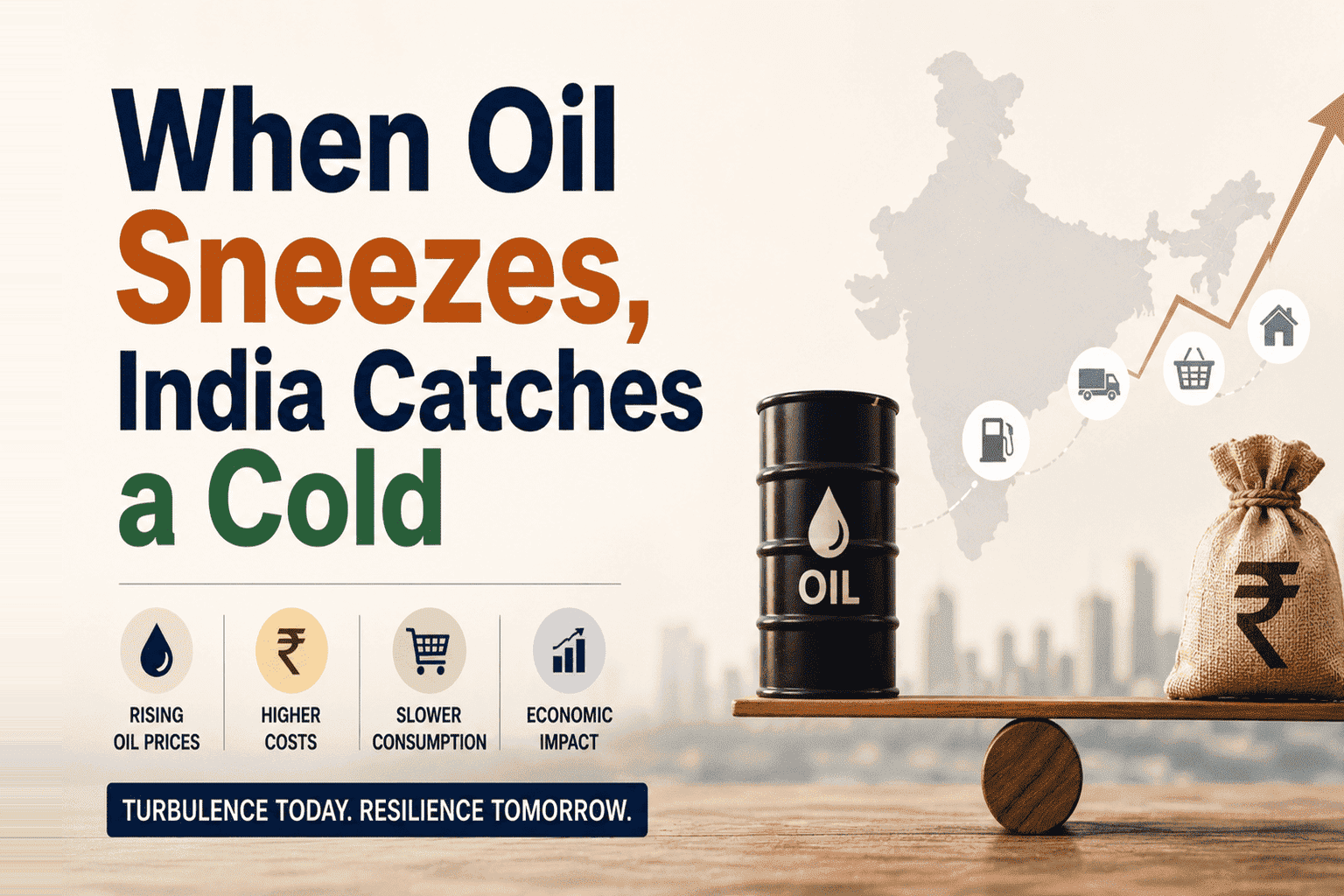
There is one commodity that quietly runs every economy on the planet. Not gold. Not semiconductors. Oil.
It moves your morning commute. It heats your food. It flies your flights. It ships your Amazon orders. And when the price moves, everything else moves with it.
We all very well know that India imports over 85% of its crude oil. That one fact alone tells you why a conflict in a region thousands of kilometres away, or a standoff at a narrow stretch of water called the Strait of Hormuz, makes headlines in Mumbai, affects businesses in Chennai, and eventually shows up in your petrol bill in Bangalore.
The Storm That’s Been Brewing
The tensions involving Iran have introduced a level of uncertainty that global energy markets simply cannot handle well. The Strait of Hormuz, a narrow passage between Iran and Oman, is one of the world’s most critical oil chokepoints. Roughly 20% of the world’s oil supply passes through it. When there is even a whisper of disruption there, oil prices spike. When there is an actual conflict, supply chains panic.
Whether the war ends today or drags on for months, whether oil tankers move freely or face risk, whether diplomatic channels open or close, all of this feeds into one giant variable: crude oil prices. And India, sitting at the receiving end as a net importer, feels every tremor.
India Held the Line — For a While
When global crude prices spiked, the Government of India and the Oil Marketing Companies (Indian Oil, BPCL, HPCL), took the hit on their own balance sheets, to protect the common consumer from sudden price shocks. This time, India absorbed the pressure for approximately 50 days before beginning to pass a portion of it on to end users. That is a significant buffer, but it has its limits.
First the Aviation Turbine Fuel (ATF) went up. Commercial LPG cylinders (used by restaurants and hotels) also saw a price hike. And then, after weighing every option, the government allowed petrol and diesel prices to rise.
This is the inevitable arithmetic of a country that cannot indefinitely shield 1.4 billion people from global realities.
What This Means for Your Wallet
When petrol and diesel become more expensive, the effect is not limited to your fuel tank. Think of oil as the circulatory system of the economy. When it gets more expensive, everything costs more.
The truck that carries vegetables to your local market runs on diesel. The autorickshaw you book runs on CNG, the price of which tracks gas prices. The flight you are considering for your next holiday runs on ATF. The factory that makes your favourite biscuit brand uses fuel for logistics and energy.
So, when fuel prices rise, here is what typically follows in Indian households:
Groceries and daily essentials get marginally costlier, as transportation costs get embedded in prices. Eating out becomes more expensive as commercial LPG costs rise for restaurants. Travel and commuting costs rise directly. Consumer goods, from electronics to clothing, see cost pressures across supply chains.
For the middle-class Indian household, this translates into a quiet but real squeeze on discretionary spending.
What Consumption Could Look Like Over the Next 3–6 Months?
If fuel prices remain elevated or rise further, over the next three to six months, here is what history and economics suggest:
Consumption of non-essentials slows down. Two-wheeler sales, entry-level car sales, and consumer durables tend to soften when household budgets are under pressure. Eating out frequency drops. Subscription upgrades get postponed.
Inflation stays sticky. The Reserve Bank of India (RBI) monitors inflation carefully. If fuel-driven inflation persists, rate cuts, which markets have been hoping for, may get delayed. Borrowing costs remain higher for longer.
Rural spending takes a hit. Input costs for farmers (diesel for irrigation pumps, fertilizers, transport for produce) go up. This squeezes rural income and, in turn, FMCG companies that depend heavily on rural demand.
Services sector feels it differently. Aviation, logistics, and hospitality companies face direct margin pressure. A passenger airline cannot easily pass on every rupee of ATF hike to the traveller, at least not immediately.
None of this is catastrophic in isolation. But if it compounds over several months, it starts to show up in GDP growth numbers.
The Bigger Economic Picture
India’s GDP growth story has been one of the few bright spots globally in recent years. But that story runs on affordable energy, strong consumption, and private investment.
Rising oil prices create a double pressure on India’s macro picture:
On one side, the Current Account Deficit (CAD) widens. India spends more foreign exchange importing oil, which puts pressure on the Rupee. A weaker Rupee makes imports costlier, including the oil itself, creating a feedback loop.
On the other side, government finances feel the squeeze. If the government tries to absorb more of the price hike (through excise duty cuts, for instance), tax revenues fall. Less revenue means less room to spend on infrastructure, welfare, and capital investment.
Neither outcome is good for growth. Most economists estimate that a sustained $10 increase in crude oil prices per barrel shaves roughly 0.3–0.4% off India’s GDP growth over time. That may sound small, but at India’s scale, it matters.
What It Means for Company Balance Sheets and Your Portfolio
Higher fuel prices ripple through company financials in ways that are not always immediately obvious. Here is how to think about it:
Companies that get hurt directly: Logistics and freight companies, airlines, paint companies (raw material costs rise), tyre manufacturers, and FMCG companies with large rural distribution networks all face margin pressure. If costs go up and they cannot pass them on to consumers quickly, profits shrink.
Companies that face indirect pressure: Retail, consumer durables, and discretionary spending sectors may see slower revenue growth if consumers pull back.
Companies that actually benefit: Upstream oil producers like ONGC and Oil India benefit from higher crude prices as their revenues go up. Refining margins can be complex, but OMCs in a rising price environment may recover some of the losses they absorbed earlier.
If you hold mutual funds, this matters. You may already be seeing some short-term underperformance, and that could continue a little longer. But the important thing to understand is that this is the nature of equity markets. They price in uncertainty before the economy fully feels it, and they recover before the headlines turn positive. Short-term noise is not the same as long-term damage.
Crisis or Opportunity? How to Think About This
Here is the honest investor’s answer: it depends on your time horizon.
In the short term, volatility is real. Consumer-facing sectors may see earnings downgrades. Inflation-sensitive sectors may underperform. Market sentiment can turn cautious.
But in the medium to long term, a few things tend to be true:
Economies adapt. Companies find efficiencies. India has shown remarkable resilience through multiple oil price cycles like the 2008 shock, the 2014 spike, the 2022 post-pandemic surge. Each time, the disruption was real, the recovery was real too.
India is also, slowly but surely, reducing its oil dependence. The push towards EVs, renewable energy, ethanol blending in petrol, and CNG infrastructure means that over a decade, the economy’s sensitivity to global crude prices will structurally reduce.
For the long-term investor, price corrections caused by macro events like this have historically been entry points, not exit signals.
For the consumer, this is a moment to review household budgets, reduce avoidable expenses, and if possible, continue your SIPs because market dips during uncertainty have consistently rewarded those who stayed disciplined.
Turbulence Is Not a Crash
Oil price shocks are uncomfortable. They are not new. India has navigated every one of them.
The government’s decision to absorb the pressure for several weeks before passing it on was a deliberate, considered move. The price adjustments we are seeing now are a course correction, not a crisis.
Will there be some pain? Yes. For investors, consumers, for certain companies, for certain sectors of the economy, the next few months may feel tight.
But India’s economic fundamentals – a growing working-age population, expanding domestic consumption, a government focused on infrastructure, and a large services sector do not change because crude oil is expensive for a quarter or two.
Stay informed. Stay invested. And do not let short-term turbulence make you take long-term decisions in a hurry.
Because in personal finance and in economic cycles patience has always been the most underrated asset.
Disclaimer: This article is published by Ara Financial Services Pvt. Ltd. (ARN-76035), an AMFI-registered Mutual Fund Distributor, for investor education and general informational purposes only. It is not investment advice or a recommendation to buy, sell or hold any investment product. Mutual Fund investments are subject to market risks, read all scheme related documents carefully. Please consult your financial and tax advisors before making any investment decision.

Shreedhara is the Founder & Director of Ara Financial Services Pvt. Ltd. He has an experience of over 2 decades in Financial Service Industry with majority of it in guiding individuals and institutions on their investments requirements.